art |
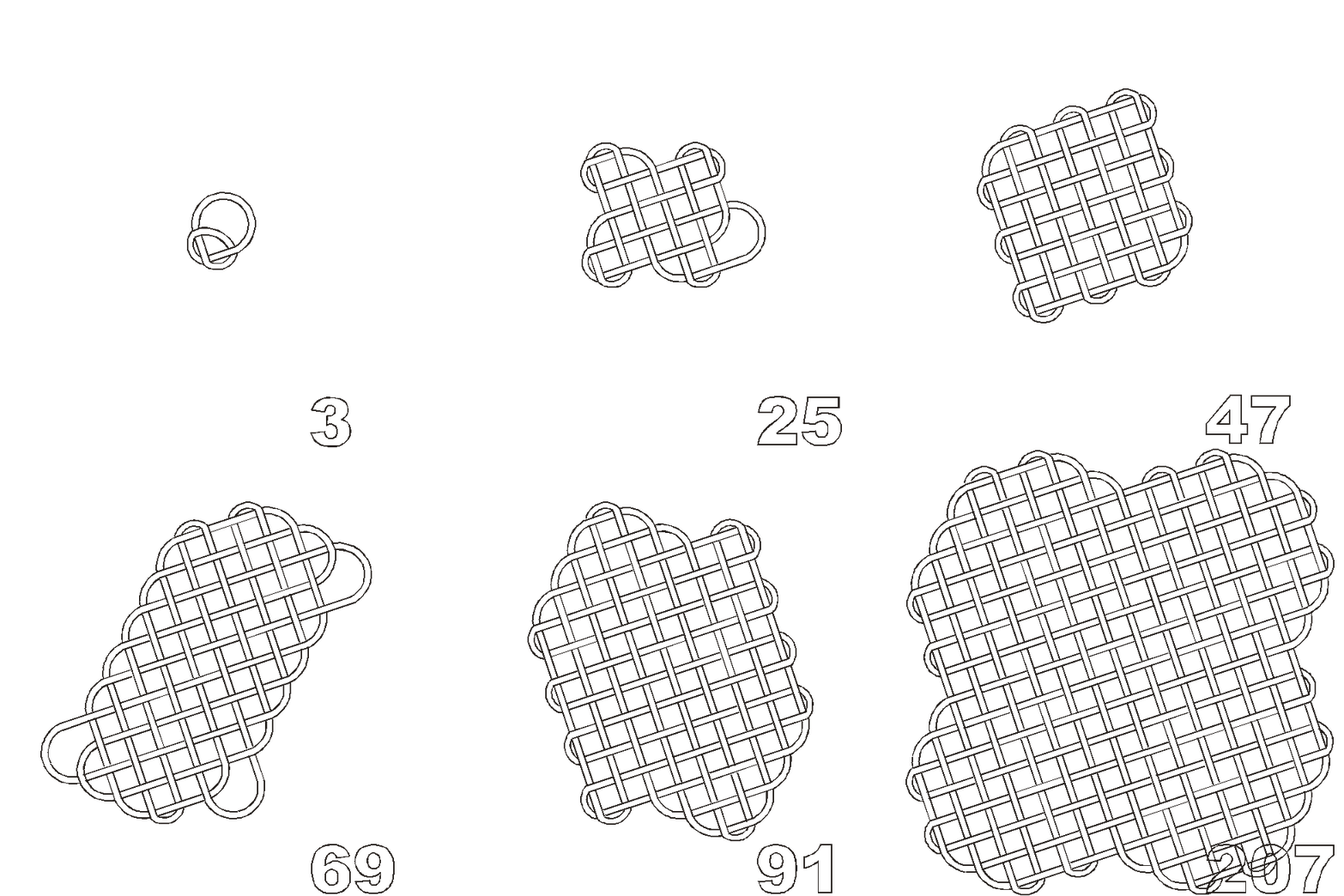 Animated Sequence, 2002 |
 Closed 22 Crossing Knot, 1968  Open 24 Ballchain Knot, 2015 |
|
The purpose of this art is to make an infinite number of knots, each with its own unique identity. The art conceptualizes a meritorious and universal affiliation system that commits every detail associated with a new knot discovery to a registry; eternally; forever. This was unfulfillable before technology's recent embrace of the autonomous distributive ledger.
The concept of making art on such an exponential scale that it challenges the mystery of the eternal act of conception itself had remained impossible in practical market terms. But like anything else imagined in the culture that presently exists, what is conceptual can also encapsulate everything the mind compulsively craves from what's imaginable, giving things value even if they are nonsensical.
The key to tapping this interconnectivity with the concept of value, in terms of the current course of civilization, is representing knots as conceptual capital - investments. The recent practice of involving the Internet in keeping and adding to a distributive ledger by applying incentives with the appearance of capital is thus adapted to the specifics of this art.
A competition for making new knots that also creates tokens to pay participants to put them in circulation does this. Through this a knot is identified with an owner, it and the token assets identified with it are added to a blockchain, and a decentralized consensus is made on the next call to begin the process all over again with a new competition. This has a different group of participants responsible for building the registry each time a new knot is created.
This process autonomously repeats itself for as long as there is an Internet to organize it and a blockchain to act as a registry.
|
 Length in 11 Knots, 1968 |
 A Conceptual Art
How A Value For Knots Is Created
The Knot
Each new knot is unique, putting it in the collectibles category of property. It is also art, making this intellectual property. Each is also identifiable with the intellectual property form, called process , in that their form follows the knot grid pattern; the knotnet; built of the modules that Infra tokens identify with. So each new knot is both the art object and the field of Infras that make the part of the knotnet that's both its supporting infrastructure and its identification with the process.
This is the way the value of the art represents capital. The identity of each component of a new knot is a return on the value of the process used to make it. A winner of the competition to make the new knot owns it, and the runners-up split the tokens applied to the process of making it. This benefit is tailored to attract Internet user/participants into investigating the value of the Infra.
The Tokens
The system creates knots as investments and Infras as tokens carrying the value of a specific knot as their worth. Tokens act as the currency that can buy a knot. Circulation of tokens as an exchange currency is keyed to giving those outside of the process an opportunity to buy in , making them collectibles, also, in the sense of being savings .


 Tokens are identified with serial numbers that can be tracked to their relation of a knot of the knotnet. As illustrated in the works above, The Infra for a three-crossing knot has the serial number 1 because it can be made on a single module of the knotnet. A three combined with another three is the second knot in the sequence and also fits on one module, but its Infra has a 2 as its serial number. When we get to the first combination pictured on the side bar, the four crossing knot has already joined the sequence and the four modules it is built on have yielded the serial numbers of these four Infras as 3 , 4 , 5 and 6 , so that combination pictured for a four and three also using four modules has Infras with 7 , 8 , 9 and 10 for serial numbers. The representations of a four with two and three three crossing knots surrounded by an indication of how high the digit count can go in numbers attempts to impress upon the consciousness how many tokens an endless generation of new knots can produce.
The knots that produce these tokens are products in an art marketplace. As creations these knots are their designer's property with proxy rights benefiting from their part in the conceptual art. They can be kept or sold. When they are sold their new value is reflected in the exchange value of related serial numbers in Infras produced when they were made. So the Infras also benefit from every value transaction that occurs.
The ICO and Startup
A house stake is created by the kickoff of this conceptual art. The number of tokens created by a number of the combination knots made from the Genesis sequence, starting with those pictured on the sidebar, are sold in what has been fashioned most currently as an ICO (Initial Coin Offering). This capitalizes the startup and initializes an exchange value for blockchain usage.
The ICO is a cold opening. It provides the first opportunity for returning tokens back into the system by creating stakeholders through sale of the knots offered, beginning with those in the sidebar. By the system's logic, these are the most valuable, and the objective is to complete their sale so the beta stage can start. The beta stage is where competitive interaction for designing a next stage of combinations from the rest of the Genesis Sequence allows knot design winners and payment in new tokens. It is the shakedown period before full autonomy is initiated.
This is a semi-autonomous phase using a comparatively small community gathered from those participating in the ICO. It will test out the design, consensus review, registry and call decision elements in the sequence control protocols using the design of combinations in the as yet undeveloped part of the Genesis Sequence.
It is from this that the play book will find its final form.
Process and Reality
Every Infra has a value inherited from its address. In the protocol of the systemic art that value is traceable in the blockchain to the value it originated from. As the value of its parent knot increases in the system relative to an ownership transfer's registered purchase, the denominational value of that knot's tokens does also.
There is a high user incentive to own low origin number knots in the address system that reflect the low complexity of the knots and their combinations in the genesis sequence. All the single knots of the genesis sequence remain in a special reserve the artist has designated as the "estate share". The tokens related to them have the higher denominational value of a preferred stock as the estate share value reflects an agrigate of the entire system's value. The tokens originating from these are in random circulation just like all the other tokens distributed in the ICO.
A Fully Autonomous Process
The real process begins when the designs of knots are made in response to a system "call", using a strictly prescribed method. This is a competition for the first to submit a match to the call. The first ten time stamped responses verify the winner.
The winning design is owned by its designer. Its tokens are divided as rewards paid to those sharing in this proof-of-work decision and the consensus operations relative to the winning design that follow. These conclude with making the decision on the next knot in the sequence that will be designed and applying the digital signatures to the block chain that releases the call to competitors. These operations always fall on the winner and nine follow-ups in the new design competition.
This is the best application of the Internet as a medium of interactivity. How acquisitions relate to value makes a tremendous difference when it comes to community values, and in that sense a community of interest in a world where reality is being challenged continually needs this identity with reality that is continuously created in this conceptual art. If its systemic continuum has the intent of demonstrating a potential expressible in this relational sense, disrupting common concepts of value may end up being the ultimate incentive to participate.
 The Great Knot, April 27, 2011 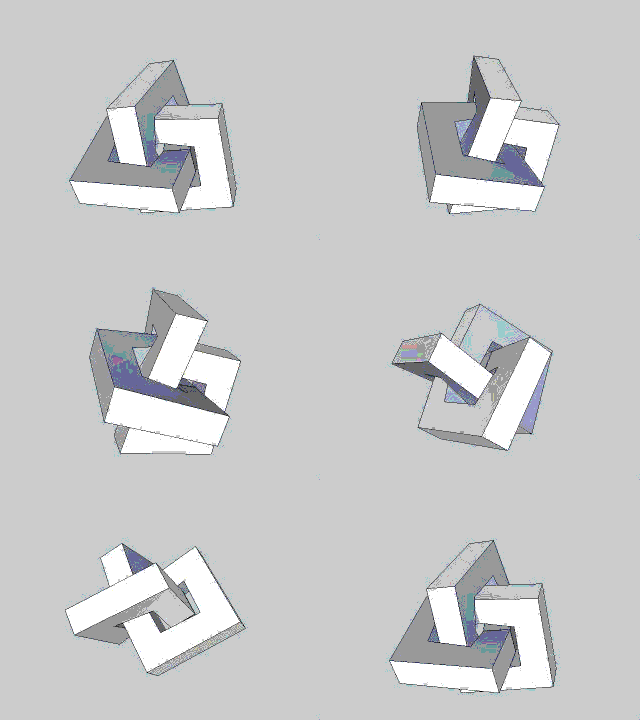 Michael Sullivan Smith, 2015 Click on animation to open parent web site greatknot.com in new browser window |