In the chain allusion, blockchain's blocks are linear additions made in chronological fashion, as in a chain of title, or abstract of provenance. In blockchain a transaction adds a block that references back in the chronology to an origin state. Alike that genesis block, new knots require agreement on the solution of a cryptographic puzzle referencing such an origin state to its sequence.
A block is only accepted to the chain after this reference is verified by an autonomous network in possession of the most current distribution of a ledger of all transactions. Only with this consensus can a new block be time-stamped into the chronology of exchanges for this particular chain of title, and its updated blockchain be distributed.
The knot is different. It has actual circuits logically connected in a sequential order, graphically, that act as the core of a decentralized autonomous knowledge base for trust.
In its protocols a value is bonded into this sequence when a particular circuit acts as the crypto identity for something, and secures a ledger for that thing, acting as its genesis block.
The system makes a transaction of this value only possible through a transaction of its identifying knot, and with an addition created to the sequence. This expands the graphics and that changes the measurements of the distributed registry, so the characteristics of the circuit identified with the value of the transaction have a new cryptographic key securing its same place in the systemic order.
The possessors of the full sequence; the distributed register ; assure a transaction by consensus when verifying this new addition, doing something similar to solving the cryptographic puzzle in blockchain, but other than that this is a different process.
What is conceptualized is a utility whose function is to base a value system on the sequence of collectible instances of this art.
This plans an imaginative use of the popularity of blockchain for registering an unending sequence of verifiable, different pseudo objects infinitely created in a process that by allusion to blockchain's distributive consensus protocols autonomously continues forever.
Using a significantly different approach, creation of knots within the strict parameters of a systemic art, the autonomous, tried and proven incentive-to-work speculation of "mining", is adapted to a "creator" paradigm for the distributed consensus concept's focus to be on fungible art objects of exchangeable value; as a commodity; instead of cryptocurrency's specie.
As the registry for systemically designed artworks, this adapts blockchain to a self-referencing use where the systemic sequencing of the art it records replaces the role the hashcode fills normally.
With this the blockchain's distributed consensus protocols are acting as a regulating device that directs participants in the art through an agreement process before provenance of ownership of a creation can be registered.
That places the "distributed register" in the role of the art medium for presenting the systemic properties of the knot. Once a beta group of participants begins bringing this toward the desired autonomous state the distributed consensus will be as associated with the knot as it is today with cryptocurrency.
The goal in propagating the properties of the knot on the conceptual level is to have this become fully autonomous through the Internet. Presently, creating collectibles and other representational works, such as The Great Knot, promote and fine-tune that goal.
In an optimal use knots identify something of value and are emblematic in transactions. A special collectible is made to represent this in the rewards that identify appreciation of patronage. This also standardizes representation of the systemic art as a series of objects that illustrate the sequence of creations in the registry. They are shown here to the right.
The greatknot.com web site and Patreon act as a presence for this art, communicating it as an enterprise and developing patrons as stakeholders. The enterprise is represented as a novel system for exchanging value.
This prospectus offers a plan that moves through four stages to build toward this future state of full autonomy.
Stage One
First, the properties and structural protocols of the previous pages here must be used in building a formal series of knot combinations, based on the range of the Genesis Sequence. The system for combining these knots in a progressive series (in the order shown to the right) standardizes the combining of knots and the numbering of each Intra created as a base for tracking consensus.
These "Digital discriptives" are made into unique objects to commemorate the origins of the order. They are planned as rare examples of the art signed by the Originator and only used as rewards to patrons.
Only the initial knots of the sequence up to the first prime knot (seven crossings) are planned to be made into these rewards. They are only made and distributed in the process of developing enough of a base in Patreon to begin decentralized autonomous operation development.
Work on programming functions for this begins the second stage.
Stage Two
All the knots that form the systemic base, with their reserved and distributed identities, are applied to a blockchain-type of programming to initiate its registry function.
In this the knot is either identified with a property or a contract. Its value can also be thought of as an empty safe awaiting something of value. The early adopters on Patreon trained in the protocols of the system's application of the registry begin making all knots promoted for this use with the initiation of the program.
That will start when the Originator opens an ICO that uses a numbering system as an initial value surrogate based on the relationship to the knot in the sequence whose location in this plan for blockchain emulation it is in.
When an exchange value for these tokens has been formalized the system can grow from the Patreon stage to the third stage.
Stage Three
A true distributed application begins when the system behaves like Bitcoin, with a competition to identify new numbered modules to make the cryptocurrency that is reward for adding each new knot to the blockchain.
When this spreads across the Internet it is expected that the token's association with the knot progression will create a market for individual knots as a denominational base in fiat currency, making the competition more rewarding, while fulfilling the investment goals of the earliest patrons.
When a demand for the earliest instances of the progression gives them a surrogate association with their child tokens, a denominational value associated with their transaction value in fiat currency initiates the forth, final, stage of this art's enterprise evolution.
Stage Four
As this perpetually evolving system of knot generation becomes the fiat key for the blockchain transaction it becomes identified as a surrogate value vehicle.
The blockchain concept of provenance tracking gives a particular knot a value as the signature of an entity.
When this function is formalized the tokens take on the role of stakeholders in enterprise associated with knot identities with the blockchain the surrogate relationship to the value of alienated entities.
In this logic the token is the choice for transactions of a growth economy and the purpose behind continuing the endless discovery of knots in the progression to keep both growing forever.
|
 The Great Knot, April 27, 2011 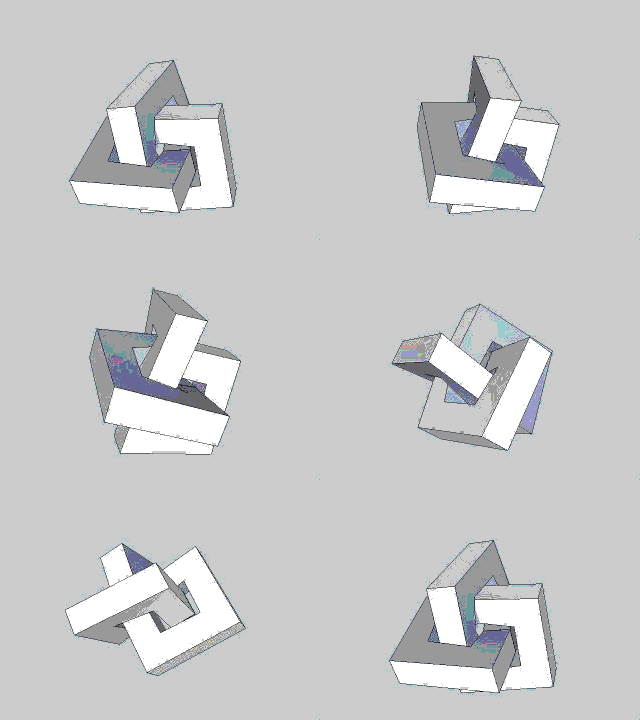 Michael Sullivan Smith, 2015 Click on animation to open parent web site greatknot.com in new browser window |