A logic for taking history seriously and the consequence of not taking history seriously is introduced with the Thruway - 1,105 words
Thruway
|
Ury had become more or less a resort where people came to enjoy the surroundings and the society. “Home” has a different feeling. The security and comfort of a place of shelter or respectable associations has little relation to the feeling of home. This feeling centers on an all encompassing sense that sharing the best of what a place means between all that hold this same feeling in common is possible. There were many that gravitated here that recognized this primal quest in each other. Of all those that grasped this true north as an element of early Saugerties, only Morris Rosenblum's forensic interests touched upon the areas and caused the changes and left the insights that today define that Saugerties as “home”.
Morris' influence began six years after his law practice was firmly established and the country entered into war. He enlisted in the army and for four years managed this practice by mail while in the Pacific acting as adjutant in military affairs and as analyst in intelligence matters. These intelligence activities involved aerial photography and on his return he brought back a love of the aerial point of view and a camera called a K-24.
Morris had embraced photography before the war and on his return he brought back a highly specialized way of using it. Comparing his quality to the photographs available of the land here drove him to plan and do his own aerial photography.
In the war Morris' mission was to confirm that surveys and maps matched what was presently in photographs of the same space. Morris had begun to collect land development records before the war and these wartime activities inspired him to broaden this into a highly comprehensive collection of historical surveys and maps to match his aerial photos. He wanted to grasp the history of a place that the lanes and hedgerows of his postwar aerial photographs represented.
What his photographs capture is a moment in the postwar era where nothing identified with forward trending dynamics like the parallel courses of the Thruway cutting through the landforms of his views. The power in this viewpoint was the transformational potential in meant. Morris' photos echoed the histories his maps told of the railroad and, before that, steamboat travel bringing change. They even hearken back to all the modes of passage that had seamlessly adapted to the grand ethos of this place; even to the sailing craft of its discovery. The assimilation of transportation change had always indicated that an historical transition is in motion.
To Morris the thruway was an indicator. The initial nine mile strip that would inaugurate the thruway concept was being put here because this was the ideal place to show off the construction of a high speed roadway. Miles of arrow-straight reaches that had guided the course of roads for centuries made it obvious that the thruway would follow a path through here in its course across the state. Its start had to wait until after the war ended and enough concrete and steel were once more available, but the economies and efficiencies found here of cement factories, railroad sidings and tide water facilities within a mile of these perfect landforms made the early start and progress needed to demonstrate its construction inevitable here.
The thruway was something Morris was aware of since well before the war. Morris was a motor enthusiast and had done many cross country tours. He greatly anticipated the promise of the high speed highway whose course had already been added to maps when the war began.
|
An early public relations identity as the “Catskills Thruway” was on Morris' mind throughout the war years. For over half a century rail and steamboat transportation had helped build a well known boarding house and resort destination as a second line economy here. This relationship to the population of the big city needed little explanation for promoting the idea of a road to rapidly reach this vacationland. The Thruway was marketed as something that would make this place more exciting and easier to reach then ever and that was the future he had planned for.
Speed was experienced in air travel and expressed in the aerodynamics of the automobile. Speed was an engineering challenge for road surface materials and developing the structure of roadbeds. It symbolized technical knowhow. The practical tests of actual road with their access ramps and entry and exit to rest areas that were happening here offered realities to match everyone's imagination. As many would be attracted for testing their hand at speed as for speeding to this vacationland.
But speed was a message that captivated more then Morris' plans. The Thruway was something else once this speed was experienced. During the war a new industry had begun to grow in this region. RCA and now General Electric had been in Saugerties and IBM was on the other side of the river to the south. This suggested that the two sides of the river would unify into one large region of electronics manufacturing. A bridge spanning the river and the Thruway would match the speed and efficiency electronics businesses identified with their products.
In the time between the end of the war when the first grading began and a decade later when the thruway had been completed to the new bridge, Morris used the keenest skills he had honed in the war to anticipate how a large industrial campus focused on the research, development and manufacture of the new concept of the computer and dozens of support businesses feeding components into this new industry from places that reached it by the three entrances of this thruway's short initial twenty mile length would create feeder communities for the large numbers directly and indirectly employed by these places. He analyzed the intelligence as new homes began to line the roadways radiating from these three entrances, banding this thruway stretch into a potential artery for suburban residential development.
This is the aspect of the thruway's future that inspired Morris to initiate events that would resonate throughout the next half century. His intention at first was to make knowledgeable decisions. The principle effect, however, was to demonstrate how the institutional memory here; of enterprise, industry, and settlement; was unprepared to cope with what all these new realities were presenting. Deep down this place had been primed by a bedrock-solid history to expect a process of housing, then manufacturing facilities, and finally centers of commerce to follow innovations. That centuries-old pattern was to be broken this time and what Morris ended up with was not quite what he expected.
|
 The Great Knot, April 27, 2011 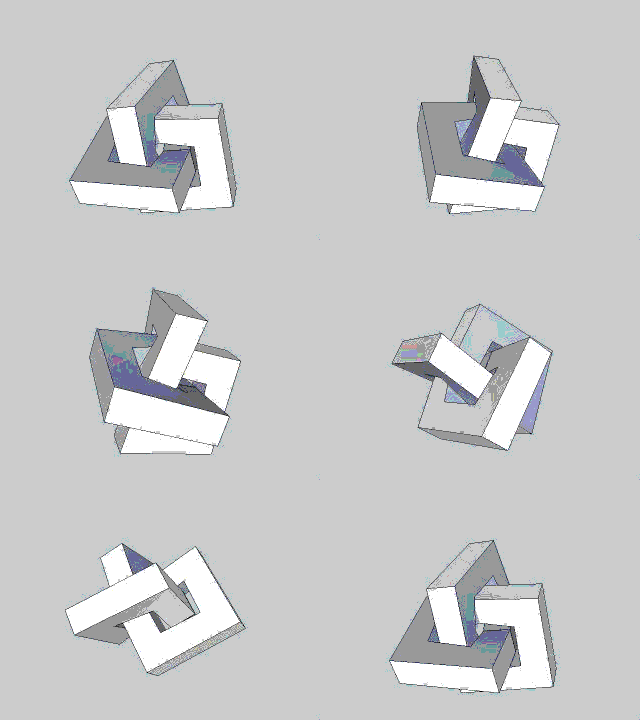 Michael Sullivan Smith, 2015 Click on animation to open parent web site greatknot.com in new browser window |