Tales of science and innovation that are inspired by natural phenomenon can count among their classics the unique history of the Glenerie lead mill - 1,161 words
The Breaks
|
The earth shattering dam break that created the land form of the Esopus Shoals also formed the Glenerie Breaks and the lower Esopus gorge. The breaks consist of a series of three bedrock shelves of different geological strata that step down in twenty foot drops from the level savanna the Esopus Creek meanders through at the two hundred foot elevation. The flow at the breaks is in an easterly direction diverting the Esopus northward flow in a zig-zag through the breaks to regain the northward flow again deep in the gorge.
The nature of the breaks was scientifically described in detail in an 1835 article for a publication called the Zodiac. What is called a “transit” is run from the base of the Catskill escarpment in a line to the Hudson River going straight through the breaks. It's analysis of the stresses on the rock that forms the cataract steps and the walls that form the break and gorge speculate for the first time on the glaceral lake it calls Lake Albany.
There had been an early saw mill near the top of the breaks but the cascades further in and steep walls made the falls further down nearly inaccessible. Col. Edward Clark managed to overcome the challenge and set up his lead mill inside the gorge in 1831. The person doing the scientific study writes in his article about Clark, his Great Falls Manufacturing Company and the atmosphere of a hermitage he had create at what was called Glen Eirie, or eagles nest.
Col. Clark was a respected civil engineer with many inventions for such things as dry docks and canal locks. His early reputation began during the war of 1812 and his testimony is frequently found in the congressional record. He arrived in Saugerties in a wave of technically oriented people seeking the common ground Henry Barclay had cultivated there.
Edward Clark found Charles Ripley there and they decided to build a processing facility for making lead pigment and grinding it into oils in an oil refinery's empty mill building below Barclay's dam, John Eldridge, Robert L. Livingston's agent, had sitting idle.
This was in the earliest of the shake-down period for applying the water to generating power to the iron and paper mills and the water was being rationed so Clark decided he wanted to experiment with his own water works and began purchasing flood rights for a dam just where the Esopus comes out of the gorge into Barclay's Pond at the second fall. This made bad blood between him and Henry Barclay .
Meanwhile Charles Ripley had attracted the interest of the Jewetts; established lead dealers in New York; for financing the enlargement of the old refinery, creating a rivalry between Ripley and Jewett's lead works and Clark's.
Clark had found that the natural dam at the lowest fall at the breaks had the drop and flow for the power he needed and could be made operational on the same schedule as his rival's expansion.
Recent information shows how quickly this took place. A surveyor's field book details a town road being laid out on both sides of the gorge between the Glasco Turnpike bridge and Clark's home and lead mill. This survey is done in April, 1833 and Clark has a house for himself built on the west side and the mill fully built on the east side of the Esopus Gorge.
When the naturalist stays with Edward Clark while writing the study published in 1835 he marvels at the refinements Clark has made in his solitary Glenerie including an iron cable suspension bridge that spanned the entire gorge.
|
Clark and Henry Barclay were both in their early 50's at this time and letter books that survive from both give insights into the pressures they both worked under; continually traveling for business to the City and dealing with transportation, material supply and post office difficulties. Both pressed through until nearly the same mid-century point when Edward Clark relinquished his business to Battelle and Renwick and moved to Brooklyn and Henry Barclay died. Both left the operations they started alive and well for the next several decades or more.
The legacy of Edward Clark's development of water power at the breaks is two-fold. First, his manufacturing operations attracted transportation into this remote and solitary environment. Second, it brought interest in the location for its possibilities. In a development plan proposed in the 1890's, as drinking water for the growing populations of cities created lucrative investment opportunities, the Ramapo Water Company surveyed for reestablishing a somewhat smaller Lake Albany by putting a dam in the breakes and plugging the Esopus back up again. That eventually was exactly what was done with the Esopus at the Ashokan.
As for lead manufacturing at Saugerties; Charles Ripley unfortunately died within a few years of the beginning of this rivalry but the patent claims continued to be argued between the Jewetts and Col. Clark. Clark's methods remained productive for decades after the Jewett's production in Saugerties ceased in the mid 1850's. A sizable community formed around the Glenerie lead mill that lasted until the last owner involved it in the Lead Trust in the 1890's and the process was consolidated into a larger location. In 1900, years before an arts colony was planned for Woodstock a group of Boston investors sought to turn it into the “Glen Eirie Workers” and this was promoted broadly in newspapers and in a custom booklet distributed in the U. S. and in England. That could have inspired Ralph Whitehead to look here for his Byrdcliffe.
“Lead works” is really a misnomer. Both inventors; Ripley and Clark; were concerned with making paint. It was not lead for pipes or for putty but oxidized for marine and house paint. The principal reason for a chemical market in these early days was for the composition of paints. Clark's main agent for sales was an old Nantucket whaling family who generations later would become Standard Oil. Battelle and Renwick's part in this stemmed from packaged paint; premixed in gallon barrels. They sold well in his business that sold pigment and mixing oils separately. When Col. Clark had financial troubles they took over the business immediately. The businesses they established from adding this product are still alive today. Paint in barrels was Clark's innovation.
The estates of Barclay Heights, far above the deep gorge whose drop makes them a “Heights”, benefited from Clark and Ripley's relationship with the chemical industry. Rising, who bought Clovelea right after W. R. Sheffield moved permanently to New York City, was in the industry, as were the Jewetts who maintained a presence longer then their mill did. Battelle had his residence there and his daughter married Judge Vanderpoel and they had their residence, Meadowside. And of course W. R. Renwick and his main executive John C. Steenken added their family influence to the estate feel of Barclay Heights.
|
 The Great Knot, April 27, 2011 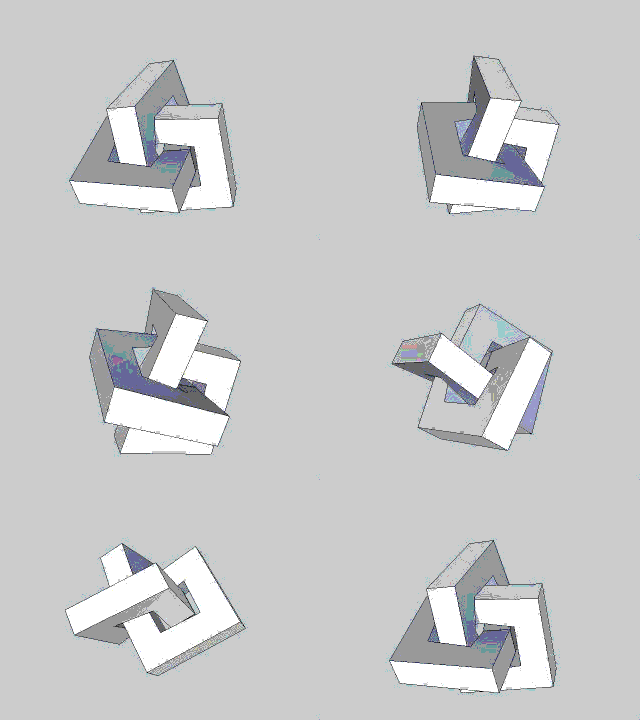 Michael Sullivan Smith, 2015 Click on animation to open parent web site greatknot.com in new browser window |