Saugerties is situated in the most attractive area to artists in America and its identity in history as a community that appreciates that the arts have many tangible expressions - 1,350 words
Clovelea
|
William Richards Sheffield captured the spirit of a unique cultural period in Saugerties that for half a century to follow resounded throughout the entire region.
Prior to 1850 the prevalent architectural style in the growing village of Saugerties was the Federal and Greek Revival. After 1850 there was a strong resurgence of pride in the colonial community's Dutch heritage and many examples of a pedestrian Dutch-style architecture worked their way into the built environment. This is evidenced in the stepped parapets of the gabled ends of structures that are dated to this period. So Saugerties already had an ample northern European influence when architects began designing structures in the later part of the 1800's such as the gate house and carriage house (1878) and mansion house (1882) of W. R. Sheffield's Clovelea.
In the last quarter of the 19th century tourism among the new social elite created an awareness of the architectural revivals in Europe, especially in the northern countries of Belgium and the Netherlands where a cultural was shared with New York City and the Hudson Valley's Dutch heritage. This resulted in a stylistic trend toward the neo-Gothic that became popular as the core of the Flemish Gothic or Flemish Modern architectural style of town houses built for the affluent new districts of upper Manhattan and the Park Slope section of Brooklyn in the 1880's and 90's. For his Clovelea, an estate house in a Hudson Valley community priding itself on this Dutch heritage, Sheffield selected this acceptable fashionable style of architecture.
This stylistic preference was much more in the spirit of Barclay Heights where Clovelea is located due to the influence of Arts and Crafts master William Morris' "Vanderpoel Window" installed there in 1874 in Trinity Church. The pictorial motifs of the window were created by the pre-Raphaelite masters Edward Burne-Jones, Ford Maddox Brown and William Morris himself and represented one of the earliest examples of that movement to appear on this side of the Atlantic. The acquisition of the Morris studio work by the architectural firm of Edward Tuckerman Potter where Alfred H. Thorp was partner was well known to New York's cultured community of the time. When Thorp was commissioned as the architect for Clovelea's mansion house the Medieval Revival theme in this pre-Raphaelite work was the reason. The growing trend toward the Gothic forms in the cutting edge of architecture fit the ambitious Sheffield's romantic personality.
The medieval artistic influences stressed in the Arts and Crafts movement's “back to basics” ideals without question led to the turn of the century creation of the artist colony in Woodstock at Byrdcliffe a quarter century later. It was the view of the Catskills from Barclay Heights that the name Clovelea references that was the attraction Saugerties had been recognized for as a gateway to artists and lovers of nature since the earliest days of the Hudson River School of painters in the 1830's. The architectural style chosen for the mansion house at Clovelea communicated an appreciation of art and nature Sheffield intended to communicate to this now growing audience.
William R. Sheffield was very sensitive to aesthetics. He had spent years planning his estate's landscaping, planting the grounds as a park setting to prepare a location for the perfect positioning and scaling of a home that fit into the view it commanded. His two earliest structures; the gate house and the carriage house; were placed within planning scheme by their architect, Joshua Cleveland Cady, as picturesque elements. They were pre-built years before to introduce a concept that would be Thorp's mansion house theme. Sheffield saw this as demanding the overall soaring form and towering pyramidal roof, popular in this time, forming an homage to the grandeur of the mountain escarpment's distant scenery; a setting he had painstakingly designed to announce. |
This view had been famous as a subject of artistic works for over 50 years when W. R. Sheffield chose it for this setting. He was well aware of the value of the scenic. Growing up at Brightbank, the original estate setting of Henry Barclay, that his father, J. B. Sheffield, purchased in 1858, his ideals were honed by one of the best views up and down the Hudson anywhere on the river.
His father died in 1879. 1882, the year Clovelea was built, William R. Sheffield was setting out to make the mark on Saugerties that would establish his personality as forward looking, ambitious and sensitive to the arts. From the base of his ownership in the Sheffield Paper Company he established partnerships that completely rebuilt the buildings of the mills. With these expanded facilities he controlled the paper product from the processing of the pulp to the bound book and succeeded in reinvigorated Saugerties' renown as a center of innovation. In a building spurt that began after the original Barclay paper mill buildings were destroyed by fire in 1873 he acquired the Ulster Iron Works and completely rebuilt them into the pulp plant, filled the shoreline beside the paper mill with an array of new buildings, and finished off with an office entry flanked by the massive blank book manufacturing plant he built facing East Bridge Street. The office building designed in the Dutch style with a massive medieval influence fireplace in its entry hall was W. R. Sheffield's public space where his business ambitions could leave as much a lasting impression as his cultural ambitions left at Clovelea. But it is clear from the engravings and photographic images he used to represent what he'd built that there was a pride in their design or arrangement that went far beyond mere functionality.
W. R. Sheffield was a man of his times. His business partnership with his father and his later enterprise partnerships were secondary to his personal ambitions. He was a major influence in Republican politics locally from 1875 and in New York City after 1890. He served as president of the Village of Saugerties and was on the boards of numerous banks and organizations here. After his relinquishment of the management of his companies in 1890, he chose to spend most of the remainder of his business life, right up until his death in 1913, as an agent and representative using his own personality and reputation and social and political connections on behalf of the paper industry.
The Sheffield estate retained ownership of the land under all the mills of Saugerties well into the 20th century. However, Clovelea, the only house that Sheffield ever built, was sold a mere dozen years after it was finished. In 1895 Edward Rising, a chemical company executive whose main residence was in New York City, purchased it for entertaining in the country following the Gilded Age trend that saw all the houses in Barclay Heights become seasonal residences of the New York City wealthy.
Rising took up full time residence at Cloverlea after retirement and died there in 1917. His wife resided there until her death and their daughter until hers. During these 68+ years of Rising occupancy Clovelea was maintained as a showpiece of the residential grandeur of Barclay Heights.
Clovelea was first applied to a commercial use as the Stonewall Hotel in the 1950's and then Anton's Restaurant in the 1960's. Subdivision of part for a motel and the separation of the gate house and carriage house later in the 1990's brought the present acreage on which the mansion house sits down to three and a half but this land included with the former mansion leaves intact control of the viewshed the house was originally designed to command.
This same viewshed is what defines the gateway of Saugerties. Clovelea is one of the few places where a perspective from a public highway connects the grandeur of a bygone era with the town and village's scenic and picturesque character. Because of this Clovelea's reputation as an "icon" is well founded. As long as it stands it will be a tangible symbol of the regional identity that Saugerties has presented to the world over the years.
|
 The Great Knot, April 27, 2011 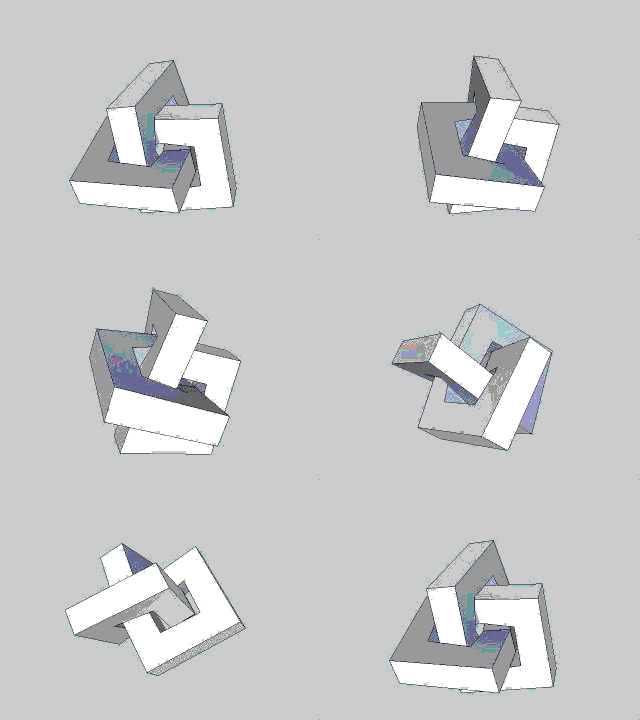 Michael Sullivan Smith, 2015 Click on animation to open parent web site greatknot.com in new browser window |