The role heritage plays in modern art in America can only be fully understood by knowing how a general history of Saugerties fits into an appreciation of Opus 40 - 1,747 words
Opus 40
|
The resources most identified with Saugerties are less those of attractiveness then they are of attractions. Where the aesthetic has drawn attention to vistas renowned as the scenes of the Hudson River School of Painters it was during the same exact period of time that the waters and land formations pictured in these natural settings were being captured and harvested as economic resources. The founder of the School, Thomas Cole, would naturally preferred a less bustling place, in Catskill, for his home and studio.
The sensitivities of these seemingly polar opposite influences, however, joined as a theme later in the twentieth century as industrial structures began attracting artists to settings of the historic region surrounding the Woodstock art colony. Beginning with the photographs of R. Lionel De Lisser in Picturesque Ulster and on through the many paintings of mills, working boats and the cubist spaces of quarries from this period, Saugerties can be recognized as a favorite location for the easel and camera.
From this period's fascination with the aesthetics of a man-made environment came perhaps the most unique and most timeless art work in the world.
Harvey Fite was born on Christmas day, 1903, in Pittsburgh, Pennsylvania, to a family with roots in Pittsburgh's hardscrabble working class. When he was still a small child the family moved to rural Texas where he grew up working along side his father farming and doing carpentry. At twenty he was accepted into the Houston Law School but left to study for the ministry at St. Stephen's College before graduating. A scholarship through his bishop made this possible.
Working with stage sets and acting at St. Stephen's drew him to the theater. In 1929 he left college to follow an acting career with the Jitney Players in Woodstock studying and acting at the Maverick Theater. He was first attracted to sculpture there while living in the Maverick artist's colony.
By his twenty-seventh birthday Fite realized he had, from a diary entry of December 24, 1929, "tried in vain to escape the work of hands by studying for the professional life". So, in 1930, he returned to St. Stephan's to complete his degree then resigned himself to work as a full time wood sculptor. He spent the early Depression years producing "work of hands" as a struggling artist.
In 1933, recognized as both a theatrical designer and a dedicated sculptor, the "professional life" came to him. He was asked to head a newly founded Fine Arts Department at St. Stephen's after it became a liberal arts college affiliated with Columbia University, renamed Bard College.
Bard today has a reputation as a free spirited school. It may be said that Fite's many year's journey of creative soul searching leading to this "work of hands" had more than a passing influence on the multi-disciplined seat of the Arts that became Bard's identity. The initial project he undertook at Bard; directing and working along side his students to hand build "Orient Hall" where performance, sculpture and other fine arts studies eventually grew into the college's signature Art Division; early defined Bard's independent character. Harvey Fite chaired this Division until his retirement in 1969 after which he continued as Professor Emeritus.
Harvey Fite's own identity as an sculptor began to surface with a 1935-36 sabbatical from Bard. He studied under the sculptor Corrado Vigni in Florence, after which his focus shifted from wood to stone carving. This shift led to his purchase in December 1937 of an abandoned bluestone quarry as a source of stone for this new medium. During winter the next year, with a Carnegie Institute Fellowship, he traveled to the Mayan archaeological site in Copan, Honduras to study and restore Mayan sculpture. Upon his return he commenced construction of a studio home at the site of his bluestone quarry, setting in motion the course that would ultimately lead to Opus 40.
From his experience in Copan we can imagine Harvey Fite first envisioning Opus 40 from his abandoned-quarry-facing home as if the rubble piles there were ancient creations - in ruin. As in Copan's ruined complex of structures, he would have imagined a monumental earthwork and formalized that rubble landscape into ideal positions for display or performance. That would have been Harvey Fite's viewpoint at this early stage in the development of his art: a stage for placing the monumental carved bluestone statues that filled his mind after Copan. What was to be Opus 40 was only a secondary consideration.
At the time Fite's concept of sculpture reflected a critical moment in the entire culture's adjustment to a new way of viewing itself. The form, scale and function of monumental undertakings during his lifetime demanded his visions as artist be large. His carved statues followed the period's popular theme of representing man as the symbolic master of monumental tasks. Statuary was made large to mount the fronts and tops of triumphal architectural and engineering achievements. Opus 40 in this context was basically a setting to showcase this grand artistic statement. |
However, Fite's artistic intent was to bring something unique to this genre. He purposely retained the stone's dimensionality and mass in the representational content of his sculptures. Citing Mayan art's influence he declared that "the artist must satisfy the aesthetic sense by working with the limitations of the material". His goal was not to carve an "idealization of a factual reality" from the stone but to blend the representational form he carved with the character of the stone itself. This same interaction also carried through in the arrangement of stones that defined the basic forms of Opus 40.
For over twenty years Harvey Fite paid homage to this concept of the stone's character in his traditional form of sculpture. All the while he continued to build the stone environment on which he displayed this statuary. A “Look” magazine photo essay of the late 1940's idealizes his country lifestyle in High Woods. In it Opus 40 had already attracted the attention of the photographer's eye. So his presence in the art world of the time is of a sculptor already building and inhabiting a special environment. Though he had many gallery shows and awards with his traditional sculpting, the dominant theme of his public image was inseparable from this ever growing artistic environment of stone.
By 1960 Harvey Fite's concept of the relationship his stone statuary had to the environment he created was beginning to change. By this time his environment had noticeably out-scaled his figurative sculptures. His sculpture appeared no longer symbolically monumental. The setting and its actual stone had become monumental. So, in his now 60's, he redirected the course of his life's work by removing the statuary from the environment and dedicating himself to transforming the land itself into sculpture. The intuitive sculptural form he had been building for nearly a quarter century thereafter became the central focus of his work. This event established Land Art as a universal theme of artistic interest for the first time.
But he had an even more expansive view planned for this new art form. As he was planning his multi-acre art environment to be a single work of art he was also developing parallel ways of experiencing the environment that would transcend the physical presence of this sculpture. He was conceptualizing a way to present the quarry itself as a narrative that interpreted the whole history of the people, their culture and the industry of the bluestone material of his artwork. This was to be an integral part of Opus 40.
The groundwork for this all began years before. Since he first bought his quarry land in 1938 Fite collected with great and growing interest artifacts from the quarrymen. With his new approach to his art he began a serious review of these quarrying artifacts. Then he reconstructed a garage into two stories with sheltering overhangs He arranged this collection on the floor and along every inside and outside wall. He arranged them as aesthetic displays with no cataloging or markings and delighted in giving "tours" where he would describe each item in relation to the life and times of its user. An early black and white video exists of one of these tours of what he called his Quarryman's Museum.
To complete this interpretive theme he cleared what he intended to be a congregating area at the base of the sculpture. In the midst of artistic elements of the site he uncovered a viewing area for the express purpose of displaying the land as it was before he arrived. What he'd seen was the work of nature; of ancient seas and of more recent glaciers; and also marks in the stone from the work of the quarrymen. In the same way that his Quarryman's Museum honored the life of the working man, this amphitheater interpreted the life of the stone.
Fite constructed Opus 40 by hand and only with nineteenth century quarryman's technology and tools - moving, trimming and setting the stone remnants left to him by the original quarrymen. Fite's narrative of tools, physical work and what the quarry becomes adds to the art through this experience. It suggests Opus 40 as a work of many long-ago hands and tools sharing the same material space through this work of his hands. The whole work is a collaboration.
This recognition of "work of hands" is Harvey Fite's individual legacy to the world of Art. Those who understand what "work of hands" means appreciate Opus 40 in a completely different way from those who approach it for its art history significance or appreciate it on a strictly aesthetic level. But one does not take away from the other. Appreciating the task of building assumes recognition of the quality of what is built. Conversely, appreciation of the quality or cultural significance of what was built presumes that an act of creativity requiring the labors of the artist happened. It is this welding of experiences that Harvey Fite sought through his art, and spent his life perfecting.
Had Harvey Fite lived he would probably have spent his later years enjoying interpreting his beloved site and collection of artifacts. This would have completed his environment. But his intentions are so obvious in the physical presence of his accomplishments that it is this; his spirit; that makes the whole artwork complete. Opus 40 is the collection, the cleared quarry and the structured Land Art sculpture as a whole.
|
 The Great Knot, April 27, 2011 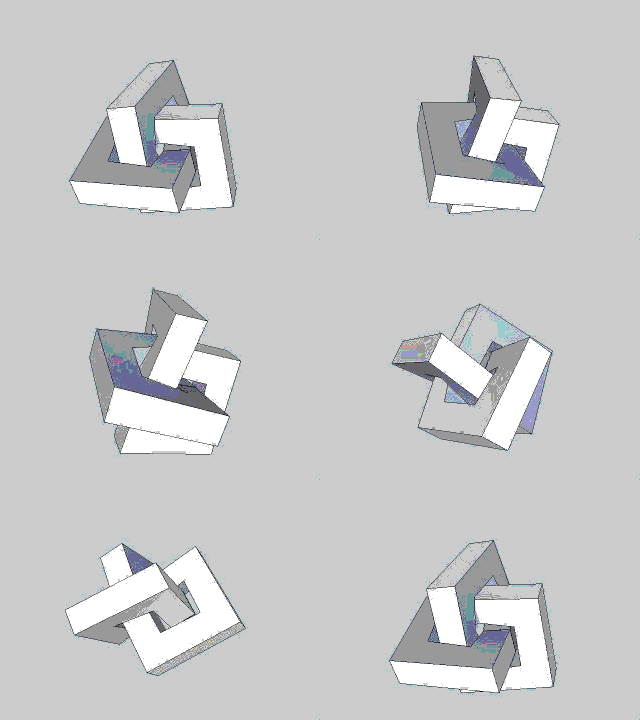 Michael Sullivan Smith, 2015 Click on animation to open parent web site greatknot.com in new browser window |