What Morris Rosenblum collected and what his entrepreneurial involvement in contemporary history made possible define what is recognized as history today - 3,059 words
Perspective
|
The Thruway opened here at a moment past mid-20th century. It only went ten miles to the north and was just a curiosity. Four years later it opened to the south another nine miles and was a curiosity twice as long. Morris Rosenblum took notice of the event by saving the easement lists and their surveys. Good thing, because for this short length of pavement; a score of miles in the face of an eventual near five hundred; as he'd expected, living memory would forget the meaning of these moments in short order. He put these maps with the original 1880 drafts of Wallkill Railroad plans and a tracing for the Bristol Turnpike easements from 1815 that he knew were already long lost to even historical memory.
It was four years and eight months since his return from the Pacific and Morris had already taken one commercial flight to Europe and gone on two hunting excursion to Canada. His high functioning personality had also logged over two thousands new cases through his one man law practice.
By this time Morris had already welcomed Dan to the firm the precious October. Dan brought a diversified reach the practice needed to progress beyond Morris' earlier base.
Morris' earliest involvements had added a certain mystique to his practice. There were assumptions about social acquaintances and professional connections and special access to proprietary information. That had made him seem professionally aloof. Dan was from generations of family here firmly related to the earliest of local blood lines and mercantile interests. He had begun his career in the same level of big city law as Morris so his addition tended to neutralize the firm's appearance of exclusivity while not diminishing the high expectations.
By 1954 Dan had grounded the partnership in the venerable century-old home of a founder of the community right beside the home of his grandparents and their hardware store in the center of a bustling business environment his family had been part of for four generations. These offices immediately became the focus of whatever Morris believed was possible.
The war had changed Morris. He had enlisted as soon as it was declared and went from buck private to captain in his four years. He was well into his third decade when he entered and fast approaching his forth coming out and had spent all the previous time adventuring as a care-free bachelor.
The reality of war, especially as an intelligence officer at the dawn of the atomic age, must have fallen heavily on this son of Jewish farmers whose family had suffered tragedy in his most formative years. His strong supportive relationship to his family up to the time he went to war had been consistently relieved with an otherwise irresponsibility in his personal life away from them that only his natural talents managed to help him through. But by the time he'd made captain in the army he was ready to put all that pent-up energy into something that resembled a legacy.
Morris had taken his passion for photography with him to war. In the late 30's he went on a road trip with his 16mm movie camera and color film cross country to the iron pits of Hibbing, the Grand Coulee Dam and Yellowstone. He was also doing 35mm color slides. All of this he took to each base in the states and then to the South Pacific where along the way he quickly learned the art of aerial cartography for surveillance and its use of specialized cameras. When he returned he brought with him one of these military cameras and, beginning in 1949, went on flights, first to take straight-down pictures like he'd learned for mapping and then, from 1954 through 1964, oblique landscape views.
What Morris got from the earliest flights, captured in those photographs, is a convergence of events centered on the construction of the thruway that was to give his extreme curiosity a constructive outlet. Ito him they spoke of a significant period of population growth on the horizon. Over the next two decades these early observations would drive his special talents, combined with others' that shared this insight, to forge the united front that became a fixture at every private conference and forum where the investment strategies and alliances were discussed.
Morris, in a singular way, cast his every presentation promoting his interests in an historical perspective where he placed everything in a tradition of planned development. He had extensive knowledge of the historic plans of the town and village and assumed the air of this special access as he put together the process of developing toward the future. To him past was prologue.
Morris represented this perspective in a portfolio. This portfolio was a one-of-a-kind book with dozens of his aerial photographs showing every square foot of the village. It was the only thing like this anyone had ever seen. The whole place was documented in extreme detail from the air.
This made the plan much more understandable than any map and Morris was the only one that showed it. It was a very personal showing. One could only see it at shoulder to shoulder closeness. It was as if Morris owned the space contained in this portfolio and he limited access to that space. And it didn't hurt that everyone knew he did this as a Mason of the highest order.
That was Morris' traveling personae. This presentation reached its fullest effect in his office and conference room with their walls covered with maps, enlargements of his aerial photographs and pictures of long forgotten local industries. He could illustrate any discussion with a quick retrieval from his large collection. His resources and his knowledge of their content was never questioned by anyone who had this office experience.
Morris had a degree in history and government and while getting his law degree had played a part in developing the key resource for interpreting corporate bankruptcy in use during the depression. He was employed by the most influential corporate law firm in the City when he moved into Saugerties. In the mid 1930's when he opened his practice here there were still firm relationships between the founding interests of early industrialization in the businesses and families of Saugerties and the business interests of the second industrial revolution in the corporate center of the City.
Morris was content since his earliest days as a lawyer to be an expediter; to make things happen. He practiced that by played a part in inspiring and organizing nearly every successful large project of the post war period. During the five years between the opening of the thruway and the first of the residential developments, he established a context of economic development based on residential subdivision that initiated the parallel processes of school centralization and highway and public works improvement of the next decade. For that entire period he was the legal counsel for the school system. Within two decades of the thruway opening, work in construction, the advent of new technology businesses, and support professions and small businesses brought in the population he expected that doubled the number of families firmly placed in the middle class salary system. This is the period that established the economy for the rest of the century.
Of Morris' selection of places to be recorded by his aerial photography, all became developed. These changes became so much part of the new population's daily life that three decades later what came before barely existed in anyone's living memory. Without Morris' record all the estates and gentleman farms and all the mills and the commercial resources that supported a village of workers before would by now have passed into utter obscurity. Today it takes some extreme detective work and a solid awareness of history to place a location in most of Morris' photographs because so many landmarks are gone.
Those photographs were taken to locate the functional landmarks of surveys, some ancient, that Morris had in his collection. When he took these aerial pictures there was still a direct correlation between the hedgerow, wall, lane, winding country road, meandering stream, and farm complex features that maps and surveys of a hundred years and more ago had with the actual lay of the land. All of this he was able to capture as clearly present in his immediate post war period photographs.
A lapse in interest can, in the course of three generations, completely erase a history that relies on verbal accounts to be remembered. What was still fresh in the surveys Morris collected before the war had no momentum or purpose after, and these records became artifacts of a forgotten way of life. Seeing this already happening in the time he had been away at war brought Morris' attention to the mysteries of all the cryptic references of the most ancient surveys in his posession whose meaning had been lost for a far longer period of time. |
A century and a half before, in the break up of a common ownership scheme in colonial times, a peculiar grid was left on all the region's large scale surveys and it was notated with references that were also found on rural land surveys and their original deeds. The impreciseness of the large division maps had attracted Morris' curiosity and he found it a challenge worth undertaking to locate the discrete markers of these surveys on a map of the larger area. This became the reason why many otherwise uninteresting drawings and blueprints entered his collection. The numbers of these and their specificity brought many surveyors to use his files and they, in turn, helped Morris build them further by filling in the missing pieces that could help him complete the puzzle.
This extended to a parallel interest in ancient deed documents and the early regional maps that noted the names of property owners. That soon broadened the collection to involve all the consolidations of properties that wealthy industrialists made to form large farms in the decade before and two after the turn of the century.
This part of the collection is what became the cache of intelligence on ownership practices that made it practical for Morris to become the central figure behind the re-division of these large farms into suburban housing lots. There is an unbroken continuation of these items in the collection into land development surveys through nearly every stage of the planning of the hundreds of houses in the subdivisions built over these farms after the war.
Morris was mentored in this compulsion to collect by one complete collection he had acquired early in this process. For nearly his entire career a fixture of his office was the survey cabinet of Judge Charles Davis; a stack of 30 flat file drawers the Judge used to hold his hand drawn maps that traced the titles to lots in the village and the original documents to confirm these, virtually from King James right up to the Judge's own time in the 1890's. Morris always kept this collection close by as the dearest of his relics. It was his Rosetta Stone.
The Judge was a good two generations before Morris, at the turn of the century. Just as Morris, the judge's imagination was driven by an aerial view of his time and Morris kept this that was also a fixture of the Judge's office framed on his wall too. That lithographic panorama of the village from a birds eye perspective would have been the first concept ever to express the idea of viewing an entire place. Judge Davis was inspired in the decade after this lithograph was produced to map the ownership transfers of over two centuries of land development as his home village pictured in this view transitioned from agrarian through roadside commerce and then manufacturing and residential up to his own time.
The Judge's research was not just driven by the revelations of his time but by the desire to access and interpret records and prove the accuracy of a growing lore that had already begun to change memory. Where Morris' interest anticipated a loss of features that marked the division of the land, the Judge's interest was in the integrity of the events responsible for these divisions. The Judge's purpose was to create a graphic shorthand that charted each interest in a property as a standard reference for finding the information his profession needed in order to protect the right to true ownership.
The Judge started collecting and creating his interpretive graphics as a young lawyer and continued refining it as he passed through political offices to finally become a judge and represent his families generations-old status as Brahmans of the community. His interest in the subject of these charts involved him in the affairs that tuned and influenced his ambitions toward the offices he had reached. Just as Morris would decades later, the Judge secured his political and professional relationships with a knowledge of the families that owned the land.
Morris held the Judge's work dear as an example of a forensic science he also required in his practice of law. As part of Morris' overall collection it reminded him to question what was missing as primary references in the common lore the Judge's work was correcting to in his lifetime.
The Judge was making no pretense at presenting history for a general understanding, but Barritt and Brink did. Davis, Barritt and Brink were all born within a year of each other. They formed the core of the mid nineteenth century generation responsible for the second wave for a local industrial vibrancy; Cantine and Sheffield. This group was to become the first home grown culture to influence the identity of this place.
The only one Morris could have known was Leon Barritt. The Judge, Brink and Sheffield were all gone before Morris was six years old. Business related to Cantine's death likely signaled the reason for his coming here. Barritt, however, was still relentlessly active as a publisher in the City throughout Morris' years there and for a few years after Morris was resident of the village. Barritt was probably one of the most interesting and most accomplished as well as long lived of this native born group.
Morris' interest in photography and in history would have had him taking notice of Barritt's groundbreaking work, The Pearl, to answer his first questions on his first arrival here. Nearly every family Morris would have come in contact with would have had an heirloom collection.
When Leon Barritt was 24 years old he published and wrote all the articles and Edward Jergenan did the photographs pasted in each issue of this innovative 1875 photo journal. At the same time as this publication Barritt was a correspondent for the regional paper and was promoting improvements for river transportation access. Every research topic central to Morris' earliest interests here was in the writings of Leon Barritt.
Morris, who grew up in the classic period of the photo journal, would have immediately recognized the significance and uniqueness of The Pearl and would have been curious about its creators. His clearest understanding of the earliest industrialized community and the forces that drove it and established the present social dynamics could have only been fully represented in The Pearl and in Barritt's narratives for the 1881 History of Ulster County.
But Dutch chauvinism; Brink's domain in Olde Ulster magazine that stressed the rural life style of agrarian work and the readiness of the patriot; ran counter to the dynamics of what Barritt had written. Brink's narrative was the most popular when Morris first encountered local history. A distant turn-of-the century romanticizing of life a century or two or more in its past was far more appealing.
Brink developed throughout his writings proofs that validated the nostalgic identity his supporters in the Daughters of the American Revolution sought for their families. Throughout his “Early History” his own family is a feature first settler and he ends this influential book before the arrival of industrialization when the population that built the community arrived.
The Brink-Barritt question of what represented the most accurate version of history; a first hand account of a more current memory or where there is so much distance in time that charm and romanticism taint the interpretation with their veils and mists; filled Morris' thoughts of home during the war and had to be on his mind as he planned what he would record on that first flight at the century mark of these popular historian's births.
As a lawyer Morris was dedicated to the forensics of the argument and from the cabinet of Judge Davis he had material evidence that much that was believed was not according to fact. He also knew that this was a delicate matter. Two generations had already cast their lot with Brink and it was the lore used to sell the rustic country atmosphere of summer lodging sites. Morris had grown up with such tales in a family in a similar line of business so he understood the strength of commitment to such a story.
So despite the overwhelming weight of his evidence Morris never entered it in the history conversation. The controversy it would generate would have interfered with his business interests. He had satisfied his need to have the best intelligence and if someone struck up a conversation on the topic he'd, at his own discretion, make a presentation that would allow them to draw their own conclusion. In this manner his collection became known to a select group only.
When Morris died five years shy of a hundred years few were left with any direct memory of the world he had known or his ever-present postwar influence. Even fewer were alive that knew of the extensive collection he had built from that period. In Morris' later years even he had begun to forget the photos and other personal connections and the contents to his large collection of survey records lost its context and became just a curiosity. Those conscious of its existence now blended it all in with the law firm's library as part of an ancient building's fast approach toward the status of mythical relic that would make its contents even more remote.
|
 The Great Knot, April 27, 2011 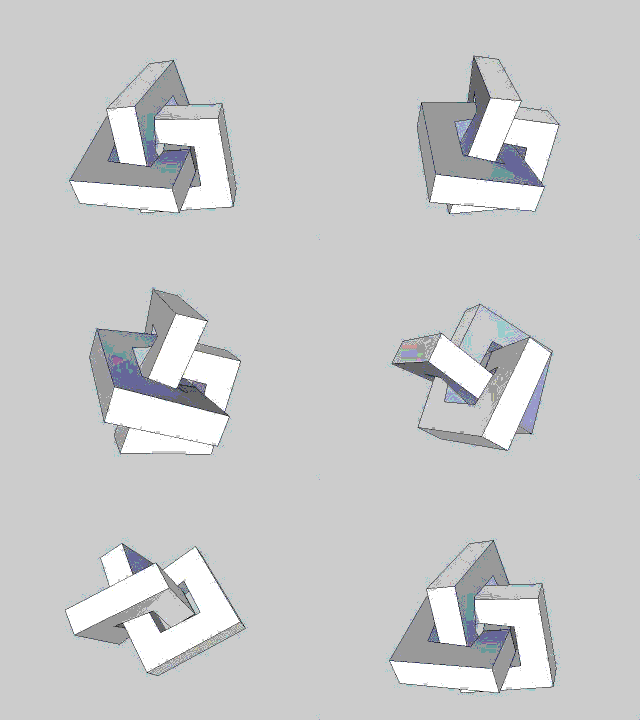 Michael Sullivan Smith, 2015 Click on animation to open parent web site greatknot.com in new browser window |